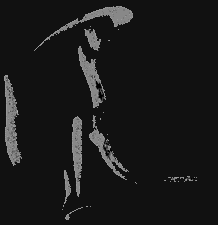
零の地平へ Ⅱ
写真美術という目印について

いつからだっただろうか。
自分の仕事を説明するとき、「写真家」という言葉だけでは足りないと感じるようになったのは。
もちろん、私は写真を撮っている。
カメラを持ち、歩き、立ち止まり、光の移ろいに目を向ける。暗室にいた時間も長かったし、印画紙の白から像が立ち上がる瞬間に胸を高鳴らせたことも数え切れない。その意味では、写真家と呼ばれることに違和感はない。
だが、制作を続けるほどに、私が向き合っているものは写真そのものより少し手前にあるのではないか、という感覚が強くなっていった。
風景を撮ろうとして出かけても、結局、私の関心は風景に留まらない。建物を撮っているつもりでも、その建物について語りたいわけではない。街角の光であれ、壁の陰であれ、水面の反射であれ、私が見ているものは対象そのものではなく、その場に生じている「何かの気配」であることが多い。
それは目の前に確かに存在している。
しかし、名前を与えた途端に逃げてしまう。
形に見えた瞬間に、別のものへ移ってしまう。
そのため、撮影は対象を獲得する行為というより、むしろ失われる前の何かに立ち会う行為に近かった。
長く続けているうちに、作品とは何なのかという問いも少しずつ変わっていった。
以前は、一枚の完成度を考えていた。構図や階調、密度や均衡。もちろん今でもそれらは重要である。だが、それだけで作品になるとは思わなくなった。
一枚の写真が成立するとき、その背後には撮影以前から続いている時間がある。
歩いていた時間。
見過ごした景色。
撮らなかった場面。
振り返った瞬間。
説明できない違和感。
その積み重ねが、ある一点で像として定着する。写真は突然生まれるわけではない。見えないところで長く進行していた何かが、たまたま姿を現したにすぎない。そう考えるようになってから、「写真」という言葉だけでは収まりきらない感覚が残るようになった。
だからといって、美術という言葉を権威として借りたいわけでもない。
展覧会に並ぶから美術なのでもない。
額装するから美術なのでもない。
市場で取引されるから美術なのでもない。
私自身、そのような基準で仕事を続けてきたわけではないからだ。
それでもなお「写真美術」という呼び方を使うのは、作品が対象の記録だけでは終わらないからである。撮影されたものの背後には、見ることそのものへの問いが残る。
なぜ、そこに立ち止まったのか。
なぜ、その光だったのか。
なぜ、その場面が離れなかったのか。
作品は答えを与えるためにあるのではなく、その問いが生まれた場所を保存するために存在している。少なくとも私にとってはそうだった。
振り返れば、制作の現場で起きていたことは、いつも単純だった。
誰もいない通り。
午後の壁面。
風の止んだ水面。
遠くの窓。
ありふれた光景ばかりである。だが、そのありふれたものが、ある日突然まったく別の深さを持って現れることがある。その瞬間に出会うために歩き続けてきた。そして、その経験を一枚の写真として残そうとしてきた。
もし私が絵を描いていたなら、別の呼び方があったかもしれない。彫刻家であったなら、別の言葉を選んだかもしれない。しかし実際には、写真という媒体を通してその経験を扱ってきた。だから写真であり、同時に美術でもある。
私にとって「写真美術」という呼称は肩書きではない。何十年も続いた実践の中で、写真を撮るという行為がどこへ向かっていたのかを振り返ったとき、最後に残った一つの「目印」なのである。
A Marker Called Photographic Art
When did it begin?
When did I start feeling that the word photographer alone was no longer enough to describe what I do?
Of course, I make photographs. I carry a camera, walk, stop, and pay attention to the shifting qualities of light. I spent many years in the darkroom, and I can still recall the excitement of watching an image slowly emerge from the white surface of the paper. In that sense, I have never felt uncomfortable being called a photographer.
Yet the longer I worked, the more strongly I felt that what I was engaging with lay slightly before the photograph itself.
I might set out to photograph a landscape, only to discover that my attention was not truly fixed on the landscape. I might stand before a building without wanting to say anything about the building. Whether it was light falling across a street corner, a shadow on a wall, or a reflection moving across water, what held my attention was rarely the object itself. More often, it was a certain presence arising within the situation.
It was undeniably there.
Yet the moment I tried to name it, it seemed to slip away.
The moment it settled into a recognizable form, it had already become something else.
Because of this, making a photograph felt less like acquiring a subject and more like standing beside something just before it disappeared.
Over time, my understanding of what constitutes a work also began to change. I once thought primarily about the completion of a single image: composition, tonal relationships, density, balance. These things remain important to me. Yet I no longer believe that they alone make a work.
Behind every photograph lies a duration that began long before the shutter was released.
The time spent walking.
The scenes passed by.
The moments left unphotographed.
A glance over the shoulder.
A faint sense of unease that could not be explained.
These accumulate quietly until, at a particular point, they settle into an image. A photograph does not appear out of nowhere. It is often the visible emergence of something that has been unfolding for a long time beyond sight. Once I began to see photography this way, the word photograph itself seemed unable to contain the entirety of the experience.
Perhaps that is why I never felt entirely at ease when the work was discussed only in terms of subject matter, technique, or genre. Important as those things may be, they seemed to belong to a later stage of the encounter. My attention kept returning to something earlier—something that could be sensed before it could be fully described.
For that reason, the work never felt complete as a record of an object. Something remained behind the photograph: a question about seeing itself.
Why did I stop there?
Why that particular light?
Why did that moment refuse to leave me?
A work, at least for me, exists not to provide answers but to preserve the place where such questions first arose.
Looking back, what happened in the act of making photographs was usually very simple.
An empty street.
A wall in afternoon light.
Still water after the wind had ceased.
A distant window.
Nothing extraordinary. Yet there are moments when something entirely ordinary suddenly reveals an unexpected depth. The world does not change, yet something within the encounter shifts. I have spent years walking in search of such moments, trying to leave traces of those encounters in the form of photographs.
Had I been a painter, perhaps I would have chosen a different name. Had I been a sculptor, perhaps another language would have felt more appropriate. But photography became the medium through which I engaged with these experiences, and it is through photography that they continue to unfold.
The phrase photographic art is not a professional label. It is a small marker that remained after decades of practice—a sign left behind while walking. Looking back, I find it standing there still, quietly indicating the direction in which the act of making photographs had been leading all along.