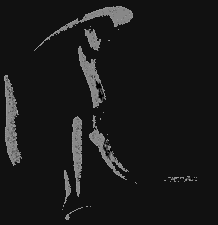
零の地平へ Ⅰ
写真美術について

写真を「美しい」と語ることは、今日では必ずしも自明なことではない。
現代美術においては、概念や制度、あるいは批評性が重要な役割を担ってきた。その成果を否定するつもりはない。しかし一方で、人が何かに触れたときに感じる美しさそのものが、しばしば説明を必要とする副次的なものとして扱われるようになったことも事実である。
私が写真に向き合う理由の一つは、その美しさがどこから生まれるのかを、あらためて問い直したいと考えているからである。
ここでいう美しさは、単なる装飾性や快楽を指すのではない。それは何かを見た瞬間に生じる反応であり、言葉による説明や意味づけに先立って訪れる感覚である。
写真は本来、対象を記録する媒体として発達してきた。しかし私にとって重要なのは、写された対象そのものだけではない。光が差し込み、空気が揺れ、空間がわずかに呼吸するように感じられるとき、そこにはまだ十分に言葉にならない何かが存在している。写真が捉えうるのは、そのような瞬間である。
私は長く、その状態を「凪(なぎ)」と呼んできた。
凪とは静止ではない。多様な力が均衡し、世界が次の姿へ移ろうとする、そのわずかな間に現れる状態である。そこでは対象と主体、意味と感覚、あるいは内面と外界が固定された形で向き合うのではなく、相互に関係しながら絶えず変化し続けている。
近年の私の関心は、そのような状態がどのような条件のもとで立ち現れるのか、という点へ向かっている。
作品が作品として認識される以前。
意味が意味として定着する以前。
世界がまだ完全には説明されていない段階。
その生成の過程そのものに注意を向ける試みが、「零の地平(Zero-Horizon)」という考え方へとつながっていった。
ここで語られる「零」とは、無を意味するものではない。何も存在しない場所でもない。それは何かが現れようとする直前の可能性の領域であり、像や意味が定着する以前の生成条件を指している。
「写真美術」とは、その生成条件そのものを描写することではない。むしろ、それらが立ち上がる気配に耳を澄ませ、経験可能なかたちとして受け取ろうとする実践である。
その探求は現在、『零式写真芸術論(Zero-Horizon Photo Art Theory)』として整理されつつある。
本稿は理論全体を論じるものではなく、写真美術と零の地平をめぐる一つの覚書として位置付けられる。
Notes Toward the Zero Horizon I
On Photographic Art
To speak of photography as something beautiful is no longer entirely self-evident.
Contemporary art has increasingly concerned itself with concepts, institutions, and critical discourse. I do not reject the achievements that have emerged from these developments. Yet it is also true that the experience of beauty itself has often come to be treated as something secondary—something that requires explanation before it can be taken seriously.
One reason I continue to engage with photography is that I remain interested in asking where such experiences of beauty originate.
By beauty, I do not mean decoration, sentiment, or simple pleasure. I mean the response that arises at the moment of encounter—a sensation that arrives before explanation, before interpretation, and before meaning has fully taken shape.
Photography developed primarily as a medium for recording the visible world. For me, however, what matters is not only what appears within the image.
When light enters a space, when air seems to shift, when a place feels as though it has briefly begun to breathe, there exists something that cannot yet be fully articulated. Photography is capable of receiving such moments.
For many years, I have referred to this condition as nagi.
Nagi is not stillness. It is a state that appears in the brief interval when multiple forces find equilibrium and the world is about to assume another form. In such moments, subject and object, meaning and sensation, inner and outer worlds do not stand apart as fixed oppositions. They remain in relation, continually changing as they emerge.
In recent years, my attention has increasingly turned toward the conditions through which such states come into appearance.
Before a work is recognized as a work.
Before meaning settles into meaning.
Before the world has been fully explained.
My attempt to attend to these processes of emergence gradually led to what I call the Zero Horizon.
The Zero discussed here does not signify nothingness, nor does it refer merely to the numerical value of zero. It points instead to a field of possibility immediately preceding appearance—a generative condition that exists before images and meanings become fixed.
Photographic Art, as I understand it, is not concerned with depicting these conditions directly. Rather, it is a practice of attending to their presence and receiving them as experience before they become fully determined.
This ongoing inquiry is currently being organized through the Zero-Horizon Photo Art Theory.
The present text is not intended as a comprehensive discussion of that theory. It is offered instead as a brief note on Photographic Art and the horizon from which it emerges.
©Naoki Kimura